



 BBC
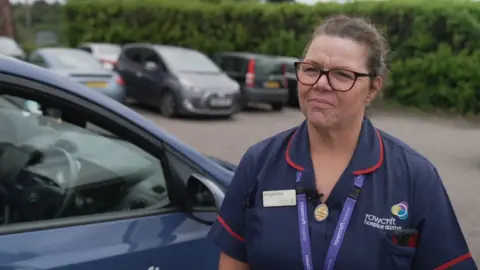
BBCAs a nurse who helps terminally ailing sufferers to die in their very own properties, Angelina Blair sees first hand the previous few hours of individuals’s lives.
“There are times where you put on a brave face, you smile, you give the care that’s right and when you leave the patient’s home you go and talk to your colleagues or maybe shed a few tears,” she says.
“Even if I’ve dealt with four deaths in a day, I’ve been able to have a family say that it was great, that mum, dad, sister was at home where they wanted to be.”
She works for Rowcroft Hospice in Torquay, Devon, which helps 2,500 sufferers and their family members every year, most of whom select to die in their very own properties.
It’s one in every of greater than 200 hospices represented by the charity Hospice UK. These are on the centre of palliative (end-of-life) care within the nation – and because of this, on the centre of the present debate over the assisted dying invoice, too.
The invoice would enable terminally ailing adults with six months or much less to stay the correct to medically finish their lives in England and Wales. A key Commons vote is anticipated to happen this Friday which might decide whether or not the invoice progresses to its subsequent parliamentary stage.
Many in assist of assisted dying say it will give terminal sufferers autonomy about how they die. However lots of these against it argue that policymakers ought to as an alternative concentrate on enhancing palliative care, and a few fear that sufferers present process end-of-life care would really feel pressured to have an assisted dying.
BBC Information visited Rowcroft hospice to grasp what employees take into consideration that debate. We discovered uncertainty over how legalising assisted dying would have an effect on their providers, and concern about funding shortages.
“I feel very passionately about people having a choice about their life and what quality of life somebody lives with,” Angelina says. “But being involved in actually administering medication that would end somebody’s life knowingly, I don’t know.”
Hospices should not absolutely paid for by the federal government. Three quarters of Rowcroft’s revenue comes from charity, corresponding to fundraising occasions, legacies and donations from native folks.
Rowcroft has solely 12 inpatient beds as most of its sufferers choose to die at residence, however different hospices have needed to maintain beds empty and lay off employees due to value pressures.
Latest will increase in employer nationwide insurance coverage contributions might hardly have come at a worse time, in line with sector leaders.
And in line with Hospice UK, the dying charge within the UK is anticipated to extend over the following twenty years, such that by 2040, about 130,000 extra folks within the UK are anticipated die every year than in 2023.
“I have no doubt, personally, if the [assisted dying] bill became law, that would be fully funded,” says Rowcroft’s chief govt Mark Hawkins.
“Shouldn’t the government be funding palliative and end-of-life care now, to a greater extent, to ensure that we all have access to the best possible end-of-life and palliative care?”
The Division of Well being says £100 million further was offered to grownup hospices in England this 12 months for buildings and tools and that the federal government is dedicated to making sure each particular person has entry to top quality and compassionate end-of-life care.
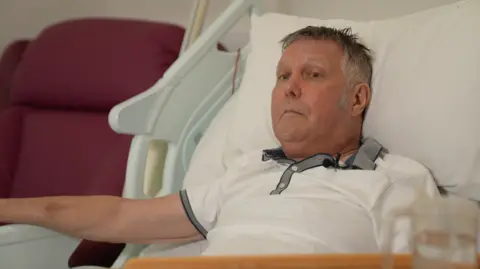
Jabez Petherick has incurable kidney most cancers. He was transferred to Rowcroft after a number of weeks in hospital, throughout which he says he had darkish and determined instances due to the ache. However he says hospice care has made a giant distinction.
“I used to go to bed, dread waking up, didn’t want to wake up, I didn’t want to wake up, because I knew the pain would start as soon as I woke up,” he says. “And gradually it stopped. And I don’t know how they did it but thank goodness they did.”
The shifting views of sufferers in some instances is one thing which Jo Jacobs, a employees nurse, has observed.
“I feel that it’s very easy when patients first come in that they feel like they want to end their life, but they change their minds.
“And it is permitting sufferers to have that alternative, however then additionally it may very well be fairly scary that they’ve opted to finish their life, however in a number of weeks’ time they’re saying one thing fully, very totally different.”
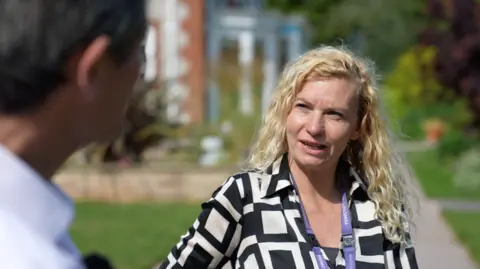
Respecting a patient’s right to choose is all important, says Vicky Bartlett, the director of patient care at Rowcroft. “For my sufferers that I am caring for, I need them to have the ability to make an knowledgeable alternative,” she says.
“And I need that option to be round assisted dying, if that turns into regulation, however I additionally need that option to be round palliative care.”
Hospices have a lot to think about as the debate on the bill progresses.
Hospice UK has welcomed a new clause in the bill which requires the government to consult with palliative and end-of-life providers.
But its chief executive Toby Porter argues there is still a lot to consider. “It’s inevitable {that a} change within the regulation would create many complicated and sometimes competing challenges,” he says.
“However the exact nature of these challenges is not going to be obvious till there may be readability on the place assisted dying would sit within the well being and social care system, and the function hospices is likely to be anticipated to play.”
He says the bill has given no details on this and there has been no formal consultation with hospices.
Pain is a key symptom for many terminally ill patients and having the choice to free oneself from the extremes of it and have a dignified death is what drives many of those in support of assisted dying.
The message from Rowcroft is that if it is made legal they will have to weigh up a number of factors, including the views of the local community and staff, before deciding whether to provide that option to patients.
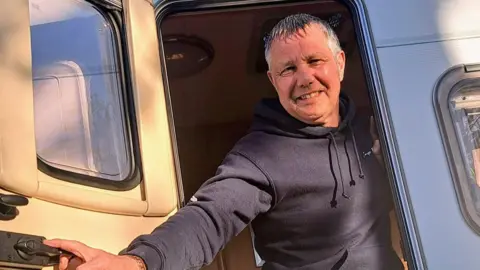
Since recording our interview Jabez has sadly died. He and his family granted the BBC permission to use his words after his death, to pay tribute to the staff at Rowcroft.
 Household handout


