




 BBC
BBCTake heed to this text on BBC Sounds
We’re driving at velocity by means of the inexperienced hills of rural Hertfordshire. By the passenger seat window, giant elegant homes flash by. Every entrance garden is neat, every hedgerow well-kept. It appears like England from a storybook – however this a part of the nation is definitely on the frontline of a comparatively new (and a few may say divisive) strategy to crime prevention.
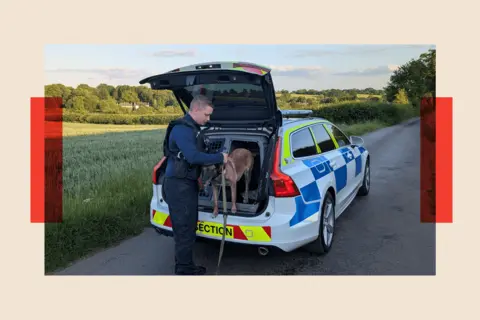
Within the driver’s seat is Robert, a guard employed by Blueline Safety. His automotive is painted with blue and yellow stripes, that means it appears so much like a police automotive. Inside there is a walkie-talkie, a first-aid equipment, and a Belgian Malinois canine known as Bella (given related coaching to a police canine, I am instructed).
However Robert – who wears a bullet-proof vest and carries a pair of handcuffs – is cautious to level out that he’s not an actual policeman.
“The more keen eye will realise that this isn’t a police car,” he says as he flicks his indicator. He factors out that they observe the laws on car markings designed to differentiate police vehicles from different vehicles.
“But it looks similar enough where criminality will see it at a distance and think, ‘Let’s maybe not go there’.”
 Luke Mintz/BBC
Blueline is certainly one of a handful of “private policing” corporations which have emerged in recent times. It has operated largely in rich enclaves of southern England since 2019 and, for a price, its workforce of ex-police or ex-army guards can patrol villages, searching for burglars and automotive thieves. Robert, in actual fact, spent 14 years working within the police power.
Numerous related companies have sprung up across the UK in recent times, together with My Native Bobby, which was based in 2016 and now has virtually 150 safety guards, in addition to a fleet of vehicles.
In line with some prospects who spoke to the BBC, this fills a niche left by the true police, who they declare they now not belief to show up promptly to a 999 name of their villages.
To residents who can afford these corporations, they’re a “lifeline”, as one buyer tells me. However to others, they symbolize an affront to the values on which British policing was based; a step in direction of a rustic through which the rich get higher entry to regulation enforcement than the poor.
One former senior determine within the Metropolitan Police says she fears the emergence of a “two-tier society”.
So, with pressures on actual police rising, is there room for personal corporations to assist ease the load – or do so-called “private bobbies” blur the strains between police and revenue?
Rise of ‘non-public policing’
The corporations providing “private policing” that I’ve spoken to say that demand for his or her companies has risen.
In line with a paper printed final yr by criminologists from the schools of Sheffield and Brunel, the UK’s non-public safety trade grew considerably between 2008 and 2021, with a rise in income and within the variety of licensed safety guards.
And, in keeping with the House Workplace, the variety of actual law enforcement officials in England and Wales fell most years from 2009 onwards, reaching a low of about 122,000 in 2017 – earlier than ticking again up, to about 147,000 final yr.
The research’s co-author, Dr Matteo Pazzona, a Senior Lecturer in Economics at Brunel College, describes a shift in policing from the “public to the private” realm. While most UK safety guards work in outlets and different companies, his knowledge does additionally sign an increase within the type of residential work carried out by non-public corporations, he says.
There are many the explanation why the safety trade might need grown over this era. However David Spencer, a former Detective Chief Inspector on the Metropolitan Police, thinks that non-public corporations may very well be filling the gaps left by police.
“If you’ve got money and you don’t feel that the police are effective, then it’s no surprise if you decide to use your resources to keep your family safe,” he says.
Confidence ‘hangs by a thread’
Till the nineteenth Century, safety from crime was largely a privilege loved by the wealthy. Rich individuals employed “thief takers” to protect their property, while odd folks needed to make do with volunteer watchmen, who targeted on the extra primary job of retaining order.
That modified when Sir Robert Peel, a Tory prime minister, began London’s Metropolitan Police – Britain’s first fashionable, skilled power funded from basic taxation.
He instilled within the power a number of ideas that may nonetheless be reeled off from reminiscence by many constables at present: being seen locally; treating members of the general public equally, no matter wealth or social standing – and maybe extra vital than all: policing with belief.
Now, some fear that belief is being undermined.
 Joe Giddens/ PA Wire
Most burglaries and automotive thefts go unsolved. A YouGov survey from final month discovered that fifty% of adults in Nice Britain held “not very much confidence” or “no confidence at all” of their native power – up from 42% in 2019.
The federal government’s police inspector, Andy Cooke, mentioned in a report in 2023 that confidence in police “hangs by a thread” (though his report final yr famous some enhancements).
Mr Spencer, who’s now head of crime and justice for the centre-right Coverage Trade suppose tank, says calls for on police time have risen dramatically. On-line fraud has shot up in current many years, and police have recognised the necessity to deal with points that had been as soon as thought-about “private” (like home abuse and sexual violence). And police sources are failing to maintain up tempo, he says.
This, he thinks, helps clarify the curiosity in so-called non-public police.
A deterrent to burglars?
Laura (who did not need to share her full identify) signed up for personal safety to patrol her street a couple of weeks in the past, after a spate of burglaries within the space. She lives in rural Hertfordshire along with her husband and certainly one of her three youngsters.
She already had CCTV put in and, on the evening that her neighbour was burgled, it confirmed a gang of masked males sitting on her backyard chairs. “You can see them looking at the camera, and they’ve seen it’s zoomed in on them. And then they went.”
Her neighbours held a gathering; about 40 households determined to subscribe to a non-public agency. Every pays £1,500 per yr. In return, guards patrol the world every day. Laura says she will be able to name a guard at any time.
“I don’t think we can afford to be confident that [the police] would get here in good time,” she says.
Nevertheless, non-public guards haven’t any extra energy than a member of the general public. The goal for a lot of is to not catch or restrain criminals however to behave as a deterrent.
 Andy Rain/EPA – EFE/REX/Shutterstock
Jamie Strickland, a former soldier who based Blueline, stresses that he doesn’t regard his enterprise as a alternative for the police and argues that even a perfectly-resourced power would wrestle to achieve distant areas of the countryside.
“The police can’t be everywhere all the time,” he provides.
However a spokesperson for the Nationwide Police Chiefs’ Council says they continue to be “resolutely committed” to attending the scene of crimes, and that each one English and Welsh police forces now goal to attend a property following each housebreaking report.
They added that non-public corporations “should not replace or supplement police and it is for properly trained officers to intervene when a crime has been committed”.
‘I am fortunate I can afford it’
The query, although, is whether or not so-called non-public police corporations sign the emergence of an unfair two-tier system, through which the wealthiest pays to be higher protected against crime.
It is a concern for Parm Sandhu, a former chief superintendent on the Metropolitan Police who left the power in 2019 and has since written a guide about her experiences of prejudice.
“If you’re living on a council estate, you cannot afford to pay for policing,” she says. “Does that mean you deserve to be burgled, sexually assaulted, or mugged? No you don’t.”
She argues that the correlation between falling police numbers and an increasing non-public safety trade alerts one thing “totally wrong”.
Andy, who additionally lives in rural Hertfordshire, close to Laura, and employs a non-public safety agency, has his personal emotions on this. “I look at it and say, ‘It’s £1,500 a year, I’m lucky I can find that,'” he says.
However he argues that not everybody who makes use of the service is rich. “You watch the CCTV [of burglaries], you feel worried for your family.” The expense, he provides, is price it for that purpose.
Nonetheless, doubts stay.
Ms Sandhu factors out that the police-like look of a few of these safety corporations may very well be complicated. “If you’ve got somebody who’s under the influence [of] drugs or alcohol, they will look up quickly and think, ‘Oh, this is a police officer’,” she says. “It’s really important to have that differential between police officers and security guards.
“Members of the general public [could] go to them pondering they’re speaking to law enforcement officials, and take their recommendation.”
Which raises the question of what, exactly, private guards can do. The companies I speak to are clear that their staff can restrain somebody they suspect to be a criminal, only in the same way that any member of the public can, a power commonly known as a “citizen’s arrest”.
And it comes with risk. Under English and Welsh law, a citizen’s arrest can only be used for an “indictable” offence – a serious crime tried at the Crown Court. You cannot use a citizen’s arrest for a lesser “abstract” offence (tried at the magistrates’ court).
In the heat of the moment, it may be difficult for a guard to judge the difference – and if they get it wrong, they could be guilty of a crime themselves.
Questions on accountability
There are also questions about accountability. Police forces are inspected by the Government’s Inspectorate of Constabulary; if a serious complaint is made against a constable, it will be investigated by an independent regulator.
Few such tools of accountability exist for private firms – other than having their licence revoked by the Security Industry Authority.
But Martin Gill, a criminology professor and the director of Perpetuity Research, a security consultancy, points out that in shopping centres and hospitals, the “majority of policing is undertaken by non-public police forces” (in other words, security guards). Most of them, he argues, do a “excellent job”.
In his view, when a private firm starts operating in a residential area, the local police force should engage.
 Getty Images
The founder of My Local Bobby, David McKelvey, says he now has a “good relationship” with police forces, after a rocky start. “There was a whole lot of reticence [from the police] within the first place, however now they’re beginning to see the advantage of [our service],” he claims.
He would like police to work closer with firms. “In the meanwhile, there is a reticence nonetheless inside policing to sharing info [and] intelligence. Usually that info is totally very important for us to do our job.”
The College of Policing has said police forces should only share intelligence under strict circumstances.
Not fairly Starsky & Hutch
Ultimately, the sort of work carried out by ‘private bobbies’ is a tiny fraction of the real police work carried out across the country. But whether more residential communities will in future opt for the private model depends largely on whether the police are able to restore public confidence, says Mr Spencer of Policy Exchange.
“If it would not, then I feel it is inevitable we’ll see extra individuals […] turning to non-public suppliers,” he says.
Back on the road with Robert, midway through his patrol, his radio buzzes. A customer has called: a horse is loose and wandering in a country lane. Within minutes, he has driven there and helped return it to its field.
It’s not quite Starsky & Hutch, Robert concedes, but it’s an insight into the sort of work they do. And yet, he admits, there are limits.
He recalls one shift, on an April night this year, when he drove along a country road in his patch and saw a car that looked like it was being used for drug dealing.
“In the event that they’ve had medicine they usually’re behind a wheel, that is a abstract offence – I’ve no energy to take care of it,” he says.
Instead, he sat in his car and called the real police.
Prime picture credit score: Getty Pictures
BBC InDepth is the house on the web site and app for the very best evaluation, with contemporary views that problem assumptions and deep reporting on the most important problems with the day. And we showcase thought-provoking content material from throughout BBC Sounds and iPlayer too. You may ship us your suggestions on the InDepth part by clicking on the button under.


