


Israel launched strikes throughout Iran on Friday, saying they focused the “heart” of Iran’s nuclear programme.
The Israeli army says Iran has launched a counter-attack, which they’re working to intercept, and a state of emergency was declared in Israel.
Hossein Salami, chief of Iran’s Islamic Revolutionary Guards – a robust department of the nation’s armed forces – was killed, Iranian state media reported, in addition to nuclear scientists.
The US stated it was not concerned within the strikes, which additionally hit Iran’s foremost nuclear enrichment facility.
When and the place did the strikes occur?
Explosions have been reported in Iran’s capital Tehran round 03:30 native time (0100 BST).
Iranian state media stated residential areas have been hit, with blasts additionally heard north-east of Tehran. The BBC shouldn’t be capable of independently confirm these stories.
In Israel, residents have been woken by air raid sirens across the similar time and acquired emergency telephone alerts.
Israel’s army stated it had struck “dozens of military targets, including nuclear targets in different areas of Iran”.
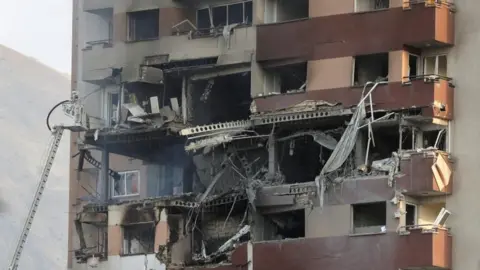
Hours after the preliminary strikes, an explosion was reported on the Natanz nuclear facility, which is situated about 225km (140 miles) south of the capital, in line with Iranian state media.
The worldwide nuclear watchdog, the Worldwide Atomic Vitality Company (IAEA), later confirmed the Natanz facility had been hit and stated it was working with Iranian authorities to evaluate radiation ranges on the web site.

 Reuters
What has Israel stated?
Israeli Prime Minister Benjamin Netanyahu stated the strikes – known as Operation Rising Lion – have been “a targeted military operation to roll back the Iranian threat to Israel’s very survival”.
He stated the operation would “continue for as many days as it takes to remove the spread”.
“In recent months, Iran has taken steps that it has never taken before, steps to weaponise this enriched uranium.
“If not stopped, Iran may produce a nuclear weapon in a really quick time. It could possibly be a yr. It could possibly be inside a number of months, lower than a yr. It is a clear and current hazard to Israel’s very survival.”
In his address, Netanyahu also thanked US President Donald Trump for “confronting Israel’s nuclear weapons programme”.
An Israeli military official told the BBC that Iran had enough nuclear material to create nuclear bombs “inside days”.
How has Iran responded?
Iran has launched around 100 drones towards Israel on Friday morning, which the Israeli military was working to intercept, according to the Israel Defense Forces (IDF).
Earlier, a spokesperson for Iran’s armed forces has said that the US and Israel will pay a “heavy worth” for the strikes, according to Reuters.
“The armed forces will definitely reply to this Zionist assault,” said Iranian spokesperson, Abolfazl Shekarchi.
What has the US stated?
US Secretary of State Marco Rubio said it was not involved with the strikes and did not provide any assistance.
He said the top priority for the US was to protect American forces in the region.
Trump has yet to comment on the strikes.
In other international reaction, Australia’s Foreign Minister Penny Wong said they were “alarmed by the escalation” and that the strikes risked “additional destabilising a area that’s already unstable”.
What is Iran’s nuclear programme?
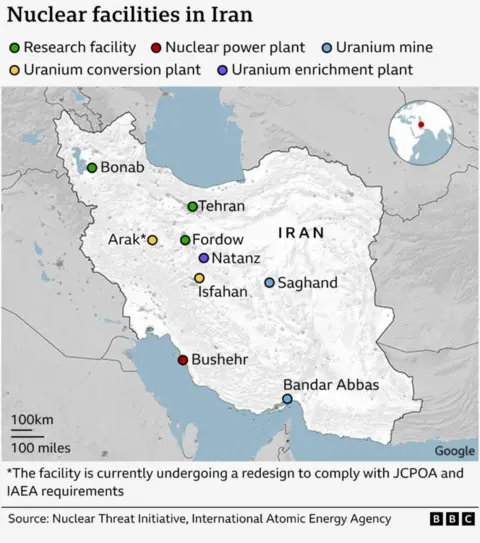
Iran has long maintained that its nuclear programme is for civilian purposes only. It has several facilities around Iran, at least some of which have been targeted in the Israeli strikes.
But many countries – as well as the global nuclear watchdog, the International Atomic Energy Agency (IAEA) – are not convinced Iran’s programme is for civilian purposes alone.
This week, the watchdog’s board of governors formally declared Iran in breach of its non-proliferation obligations for the first time in 20 years.
It cited Iran’s “many failures” to provide full answers about undeclared nuclear material and Iran’s stockpile of enriched uranium.
An earlier IAEA report said Iran had enriched uranium to 60% purity, enough near weapons grade uranium to make nine nuclear bombs.
Who has been killed?
The IDF said the chief of staff of the Iranian Armed Forces, Commander of the Iran’s Islamic Revolution Guard Corps (IRGC) and the Commander of Iran’s Emergency Command “have been all eradicated within the Israeli strikes throughout Iran”.
Iranian state media reported that those killed included Hossein Salami, the commander-in-chief of the IRGC, Gholamali Rashid, the commander of Khatam-al Anbiya Central Headquarters, and the chief of staff of Iran’s armed forces, Mohammad Bagheri.
Two nuclear scientists were also reported to have been killed – Fereydoon Abbasi, former head Iran’s Atomic Energy Organization, and Mohammad Mahdi Tehranchi, who was involved in Iran’s nuclear weapons programme.
Ali Shamkhani, senior adviser to Iranian Supreme Leader Ayatollah Ali Khamenei, was also reported to have been seriously injured, according to Iranian reports.
The BBC shouldn’t be capable of independently confirm these stories.


