


Science correspondent

 NASA/Johns Hopkins
The row between Donald Trump and Elon Musk over a significant spending invoice has exacerbated uncertainty over the way forward for Nasa’s funds, which is going through deep cuts.
The house company has revealed its funds request to Congress, which might see funding for science tasks reduce by almost a half.
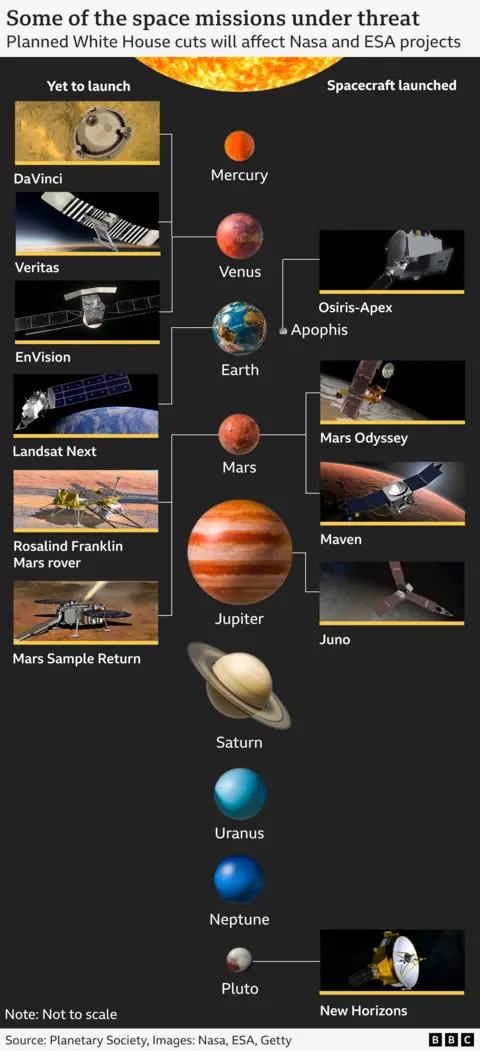
Forty science missions, that are in improvement or in house already, are in line to be stood down.
The president has threatened to withdraw federal contracts with Musk’s firm, House X. Nasa depends on the agency’s Falcon 9 rocket fleet to resupply the Worldwide House Station with crew and provides. The house company additionally expects to make use of its Starship rocket to ship astronauts to the Moon and ultimately to Mars as soon as it has been developed.
Dr Simeon Barber, an area scientist on the Open College stated that the uncertainty was having a “chilling impact” on the human house programme.
“The astonishing exchanges, snap decisions and U turns we’ve witnessed in the last week undermine the very foundations that we build our ambitions on.
“House science and exploration depends upon long run planning and cooperation between authorities, corporations and tutorial establishments.”
 BBC Information
Aside from the feud between the President and Mr Musk, there is also concern about deep cuts requested by the White House to Nasa’s budget.
All sectors have been earmarked for savings, apart from an effort to send astronauts to Mars, which has received a $100m (£736,000) boost.
According to Casey Dreier, chief of space policy for the Pasadena-based Planetary Society, which promotes space exploration, the potential cuts represent “the largest disaster ever to face the US house programme”.
Nasa has said that its request to reduce its overall budget by nearly a quarter “aligns (its) science and expertise portfolios to missions important for the exploration of the Moon and Mars”.
Dr Adam Baker, a space analyst at Cranfield University told BBC News that if these proposals are approved by Congress, it would fundamentally shift the agency’s focus.
“President Trump is repurposing Nasa for 2 issues: to land astronauts on the Moon earlier than the Chinese language and to have astronauts plant a US flag on Mars. Every little thing else is secondary.”
 NASA
NASAThose who back the proposals say the White House’s budget has given Nasa a clear purpose, for the first time since the days of the Apollo Moon landings of the 1960s and 70s, when the aim was to beat the Soviet Union to the Moon. Nasa’s critics say that since then the space agency has become a bloated, unfocussed bureaucracy which routinely goes massively over budget in its space missions and wastes taxpayer’s money.
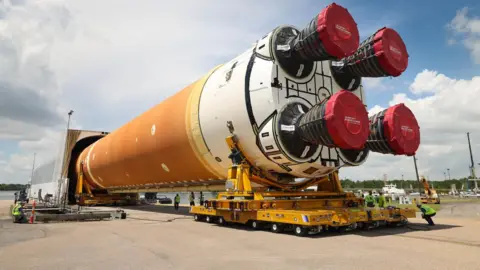
One of the most egregious examples of this is Nasa’s new rocket for its plans to return American astronauts to the Moon, the Space Launch System (SLS). Its development has been delayed, and costs have spiralled such that it costs $4.1bn (£3.3bn) for each and every launch. By contrast, SpaceX’s equivalent rocket system, Starship, is estimated to cost around $100m (£80m) per launch because it is designed to be reusable. Jeff Bezos’s Blue Origin space company promises similar savings for its proposed New Glenn rocket.
To no one’s surprise, SLS will be phased out under the White House proposals, in the hope that Starship and New Glenn can take its place. But the past three development launches of Starship have been unsuccessful, and Blue Origin has only recently begun to test its Moon rocket.
“The concern is that Nasa could also be leaping out of the frying pan, into the fireplace,” says Dr Barber.
“The event of those options to SLS is being bankrolled by Elon Musk and Jeff Bezos.
“If they lose their appetite for this endeavor and SpaceX or Blue Origin say they need more money to develop their systems, Congress will have to give it to them,” says Dr Barber.
Of higher concern, says Dr Barber, is the potential lack of 40 missions to discover different planets and to observe the influence of local weather change on Earth from house, a lot of which contain collaborations with worldwide companions.
“I think it is very sad that what has taken so long to build can be knocked down with a wrecking ball so quickly with no plan to rebuild it afterwards.”
The tasks going through the axe embody dozens of planetary missions already in house for which many of the improvement and launch prices have already been paid for, with comparatively small financial savings proposed on their working prices.
 Getty Photographs
Additionally underneath risk are two collaborations with the European House Company: An formidable plan to carry martian rocks collected by Nasa’s Perseverance Rover again to Earth and a mission to ship Europe’s Rosalind Franklin Rover to the crimson planet to seek for indicators of previous life.
Prof Sir Martin Sweeting, head of the UK house agency Surrey Satellite tv for pc Expertise Ltd, and co-author of a Royal Society report on the way forward for house says that whereas the event was “unwelcome”, there could also be an upside for Europe because it takes higher accountability for its personal house exploration programme.
“Maybe we have been too reliant on Nasa the big player to carry a lot of the emphasis in space,” he informed BBC Information.
“It is an opportunity to think about how Europe wants to get a better balance in its space activities.”
However there may be far more draw back for Europe within the quick time period. In addition to the return of Mars samples and its Rover, ESA dangers diminished entry to the Worldwide House Station whether it is wound down, and the funds cuts cancel Nasa’s intensive contributions to its successor, the Lunar Gateway, a multinational house station deliberate for orbit across the Moon.
 NASA
NASAIn its not too long ago revealed technique ESA said it “will be seeking to build a more autonomous space capability, and to continue being a reliable, strong and desirable partner with space agencies from around the globe,” with the implication that it might achieve this with or with out Nasa.
Additionally going through cuts are quite a few present and proposed Earth Statement programmes in keeping with Dr Baker.
“These Earth observation programmes are our canary in the coal mine,” he informed BBC Information.
“Our ability to predict the impact of climate change and mitigate against it could be drastically reduced. If we turn off this early warning system it is a frightening prospect”.
The funds proposals have but to be authorized by Congress. The planetary Society’s Casey Dreier has informed BBC Information that many Republicans have informed lobbyists privately that they’re ready to vote towards the cuts.
However, Mr Dreier worries that there’s a robust risk that political gridlock may imply that no funds shall be agreed. It’s possible that the diminished White Home funds can be put in place as an interim measure, which may then not simply be reversed, as a result of as soon as house missions are turned off it’s exhausting, if not inconceivable, to start out them up once more.


